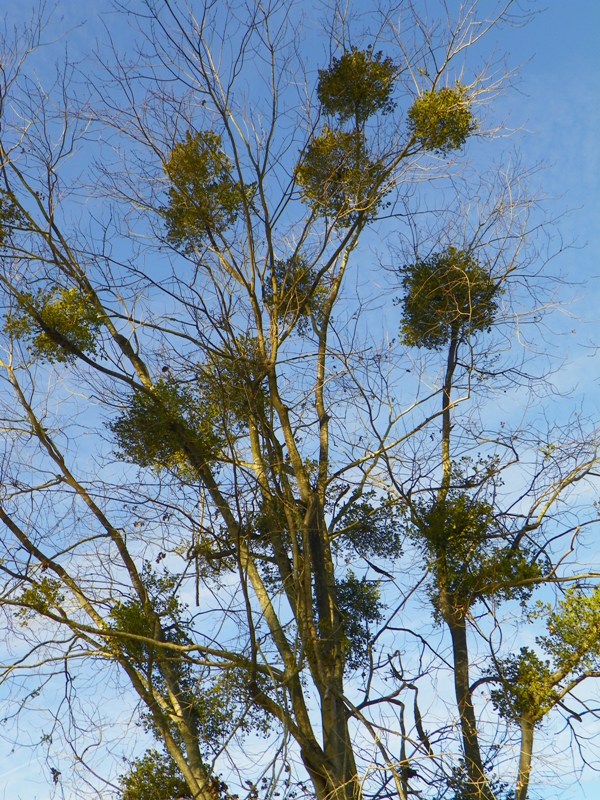
European mistletoe (Viscum album)
All around North America and Europe, mistletoe is used as
a Christmas decoration. Yet, this evergreen plant is one of the strangest, from
a morphological and a biological point of view.
The European mistletoe is a hemi-parasitic plant (i.e. parasitic with some photosynthetic abilities)
that survives by driving its roots into the bark of a host tree and sucking water
and nutrients off of it. It can be found over 200 different trees and
shrubs in the Northern Hemisphere and can easily take down a healthy host in
case of large infestation.
During the winter, it produces white berries that contain a
green seed surrounded by a viscous substance – the viscine. In the spring, the
seeds, stuck to the host tree by the miscine, will germinate. A cylindric
organ, the hypocotyle, will emerge and will orientate within a few weeks towards
the host plant through negative phototrophism (the hypocotyle basically flees
the sunlight, which is quite rare because most plants use positive
phototrophism). Once contact has been made with the bark, the tip of the
hypocotyle turns into a fixation cone that will reinforce the fixation of the
seed, already attached to the host plant by the viscine. At this stage (in
July), the mistletoe is no longer free-living.
During the growth, the hypocotyle presses the host tissues so
that the cone literally pierces the bark of the host and reaches the
layer of so-called living wood – the xylem (used to transport water and
nutrient in vascular plants). The penetration of host tissues is facilitated by
the production of hydrolytic enzymes by the cone and will take several months. During
this process, the cone turns into a primary sucker that divides itself into
secondary suckers that siphon water and nutrients from the xylem.
After this first winter, the mistletoe will grow and the
suckers will keep contact with the xylem of the host without being compressed
by the growth of the host. The mistletoe undergoes a dichotomic growth, a
growth process quite widespread in algae but very rare in embryonic plants
(i.e. plants that produce seeds). Actually the growth of mistletoe – symporadic
growth – differs from typical dichotomic growth in that the terminal bud always dies within a year, leaving two auxiliary buds develop. It will take four
to five years for the mistletoe to produce flowers and berries.
In the Anglo-Saxon paganism, the mistletoe is associated to
Freya, the goddess of love, beauty and fecundity. The custom tells that a man
had to kiss any maiden who is under a mistletoe sheaf placed under the roof. In
the Gaelic world, druids considered mistletoe as a sacred plant. They believed
the plant had miraculous properties that can be used to cure disease and
protect humans against witchcraft. In these times, if enemies were to encounter
under mistletoe in a forest, they had to disarm and observe a truce until the
following day. This would have led to the custom of suspending mistletoe to the
roof and to kiss under it as a sign of friendship and goodwill. Since the age
of the druids, the medicinal properties of the plant have been uncovered and
many drugs made from mistletoe are used in Europe to treat hypertension, to
prevent atherosclerosis and to slow down the progression of cancer.