vendredi 20 janvier 2017

Communication between phages alters infection spread in bacterial populations


A growing amount of research evidences how co-infections can alter infection likelihood in a wide range of organisms. Most of this work has focused on how weakened host defences can facilitate new infections, hence contributing to the spread of directly-transmitted parasites in a population. This situation can lead to vicious circles and trigger disease outbreaks (reviewed in Beldomenico & Begon 2010). The work by Erez et al. (2017) presents new perspectives on how infections can disease spread in host populations.

This work focuses on phages infecting bacteria (Bacillus subtilis). These pathogens can enter lytic or lysogenic life-cycle when invading the host. While the lytic cycle allows high replication from the phage, its strong virulence also leads to the death of the host. Phage lysogeny implies the phage to integrate the host DNA, providing it resistance against further infection from the same pathogen, and replicates with the host cellular division without killing the host. Lytic life-cycle is thought to be advantageous when hosts are abundant in the environment while lysogeny is seen as an advantage when the probability of infecting new host cells is low (see Chibani-Chennoufi et al. 2004). However, the mechanisms inducing lytic over lysogenic transmission are still poorly known (Davidson 2017). 

The study by Erez et al. evidences that communication between phages can influence life-cycle determination in phages. By infecting B. Subtilis bacteria with four different phages, the authors found one of the phages, phi3T, to protect hosts from infections by the same pathogen by promoting phage lysogeny. The authors suggested that the phage protein AimP triggers the release of a peptid fragment they called Arbitrium from infected cells. When this compound is taken up by neighbouring cells, high concentrations would favour lysogeny while low concentrations would favour lytic infections by phages. This study is the first to evidence such a quorum sensing mechanism in phage and could change our perception of life-cycle determination.


mercredi 16 novembre 2016

Journal Club - Warming on chytrid infections in lake phytoplankton

To start this fall's journal club, I could not resist introducing my colleagues to the fantastic world of parasites... To fit the interests of my research group at LOG, I decided to present the work done by Frenken et al. (2016 Global Change Biology) on the role of water temperature on chytrid parasites epidemics in phytoplankton spring blooms.

Chytrids are fungi mostly infamous for contributing to the worldwide decline in amphibians. However, most chytrid species actually live in the oceans or in freshwater ecosystems, where they infect phytoplankton. Their life-cycle involves a free-living stage, the zoospore, which is infective to host cells to which is attaches in order to reproduce.


Using mesocosms, the authors investigated how 4°C rises in water temperature could influence phytoplankton spring bloom through its effects on one of its major factors of termination, chytrids. After introducing a range of organisms (including zooplankton, bacteria, phytoplankton and the parasites) filtered from pond water, they followed the plankton community over 4 months, including weekly samples of the phytoplankton community.

Their results indicate that warming affected chlorophyll-a concentration in the mesocosms so that values were generally higher in the control treatment reflecting regular temperatures, with a lower bloom maximum in the warm treatment. Earlier bloom termination in warm waters were associated with a more rapide increase in chytrid prevalence in the phytoplankton community. A rapide decline in prevalence was also found at warm temperatures to be associated with low host cell densities. However, this led to a longer persistence of the bloom and of the epidemic.

Changes in the water chemistry during the experiment also led the authors to question the effects of phosphorus limitation for chytrid epidemics, suggesting that high C:P ratio may have constrined the growth of the parasite. Importantly, their results also indicate that at warmer temperatures, zooplankters such as rotifers have an early development time and that under these circumstances, zooplankter population growth follows the rise of chytrid prevalence in the phytoplankton community. Because zoospores can be preyed upon by a number of organisms composing the zooplankton, it seems likely that these organisms used chytrid zoospore as an alternative food of resources at warm temperatures.

Overall, their results stress the need to understand the complex effects of global warming on phytoplankton bloom dynamics and emphasize the importance of considering parasites in such questions.


source for picture: http://cfb.unh.edu/phycokey/Choices/Anomalous_Items/fungi/Chytrid_05_500x317_on_Ast.jpg

lundi 24 octobre 2016

Final DEVOTES Conference


Last week was held in Brussels the final DEVOTES conference. DEVOTES is a collaborative project that run from 2012 to 2016 with the overall goal of better understanding the relationships between pressures from human activities and climatic influences and their effects on marine ecosystems. Its leaders, Dr.Angel Borja and Dr. Maria C. Uyarra from the Marine Research Division of AZTI-Tecnalia in Pasaia, Spain coordinated the project to link its work to the management of European seas to reach and or maintain a “Good Environmental Status”. 


The programme reflected efforts to merge the worlds of managers and researchers by involving presentations from both stakeholders and scientists. Among the works presented during the event, the NEAT (Nested Environmental status Assessment Tool) software seems to break the boundaries between research and management of marine waters as it allows an assessment of biodiversity status and of GES across regional seas while also indicating the uncertainties related to the assessment. This tool has far reaching possibilities as it is not restricted to the EU Marine Strategy Framework Directive and can be used for other needs (e.g. national assessments). More about it here.


mardi 11 octobre 2016

EcApRHA: Applying an ecosystem approach to (sub) regional habitat assessments

The EU Marine Strategy Framework Directive (MSFD) has for main objective to achieve or maintain 'Good Environmental Status' (GES) in European Seas by 2020. The development of common criteria and methods during the first phase of implementation of the directive is essential to ensure consistency and comparability in the determination of GES and, hence, to guide policy makers in shaping future marine monitoring and assessment standards. To this end, a number of criteria and indicators have been notably identified to define GES on the species, population, habitat, and ecosystem levels. The biodiversity theme of MSFD gathers 4 descriptors (D& Biodiversity, D2 Non-indigenous species, D4 Food-webs, D6 Sea-floor integrity) with overlapping data requirements in biodiversity assessments, although the meaning of GES varies for each descriptor. However, MSFD implementation requires scientific and technical developments to conceptually frame biodiversity and to achieve meaningful monitoring and assessment of biodiversity.


The EcApRHA project is a 15 month project co-financed by the EU DG Environment running from December 2015-February 2017. It is co-financed by the EU DG Environment and will be implemented through collaboration of nine partners under the coordination of the OSPAR Secretariat (Convention for the Protection of the Marine Environment of the North-East Atlantic). 

EcApRHA focuses on overcoming challenges that are identified in the process to deliver regional biodiversity indicators for application of the MSFD for pelagic habitats, benthic habitats and foodwebs. These are challenges in access to and use of data, developing options for improved coordination of monitoring, how to construct regional indicators and undertake assessments of the indicators, as well as how these might fit together across scales and biodiversity components to work towards a more ecosystem approach.

The project aims to deliver:

- improved habitat and food web indicators to contribute to the Intermediate Assessment in 2017. This OSPAR assessment will be acommon regional report for relevant EU Member States to use in their national reporting on the state of the marine environment in their waters under the MSFD; 

- an Action Plan, recommending the steps to be taken by Contracting Parties to address the identified gaps and shortcomings to enable to achieve an ecosystem approach for (sub)regionally coherent habitat assessment.


vendredi 23 septembre 2016

EcApRHA Project: Ecological Approach to (sub) Regional Habitat Assessments

Two weeks ago, we were meeting with fellow researchers, OSPAR secretariat and with policy makers in London for the 3rd EcApRHA meeting.

During the round tables, we discussed progress on the development of indicators of the 'Good Environmental Status' for North-East Atlantic regions under the EU Marine Strategy Framework Directive.

Things keep being quite hectic but I'll write more about this in the future.

More about the meeting here: http://www.ospar.org/news/ecaprha-first-wp4-ecosystem-perspective-workshop 


Source for picture: http://www.ospar.org


And a picture of the afterwork dinner...


samedi 26 mars 2016

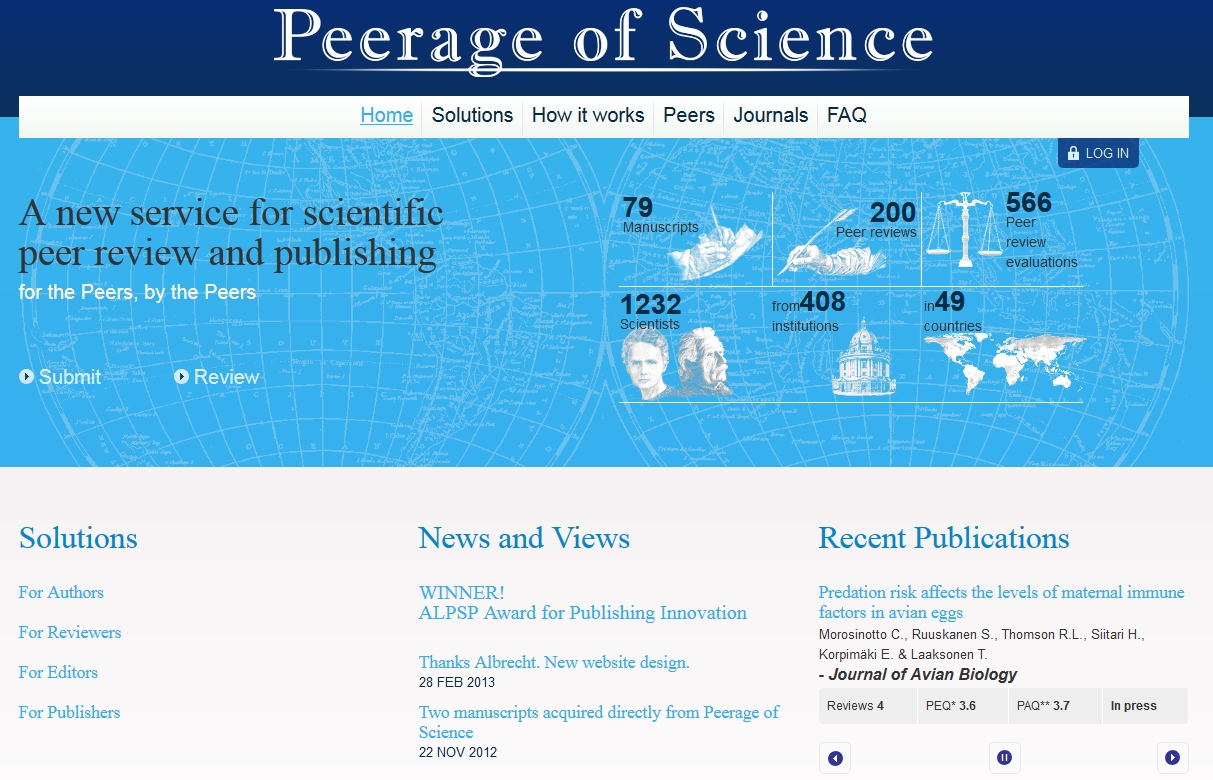
In the top 10 best peer reviewers for Peerage of Science!

Peerage of Science is a free service for scientific peer review and publishing founded in 2011 by Finnish ecologists Janne Kotiaho, Mikko Mönkkönen, and Janne-Tuomas Seppänen. One of its main purposes is to develop the practice and the evaluation of science.

Anyone having produced a publication as first author can become a peer and review the submitted manuscripts. Peer-reviews are evaluated among reviewers, giving more or less weight on some of the reviewers' suggestions to the manuscript.


In order to further promote the interests of the researchers registered as users of the company’s services, Peerage of Science awards every year The Reviewer Prize, to the best peer reviewer of the preceding year, as determined by performance judged by the evaluation of peer reviews.

Halfway to the final ranking, I had the surprised to be notified by Janne-Tuomas that I made it into the top 10! A nice surprise that adds to the experience I gained in this new reviewing experience. Let's see if I can keep up in the next 6 months :)


More about Peerage of Science here and here.


Source for picture: http://book.openingscience.org/images/novel_scholarly_journal_concepts_3.jpg

mardi 22 mars 2016

Parasite humour


Yes... I laughed.... And I am... Still... !


I have been traveling a bit and I still have to move out of my flat by March 31st, so no serious post this month ;)


Source: http://www.sadanduseless.com/2014/05/hipster-photo-revisions/